
Federal Court Rules that the Department of Veterans Affairs Must Provide Veterans with Explicit Notice When It Denies Claims
–In landmark decision, Court strikes down judge-made policy that allowed VA to implicitly deny claims–
FOR IMMEDIATE RELEASE: February 04, 2026
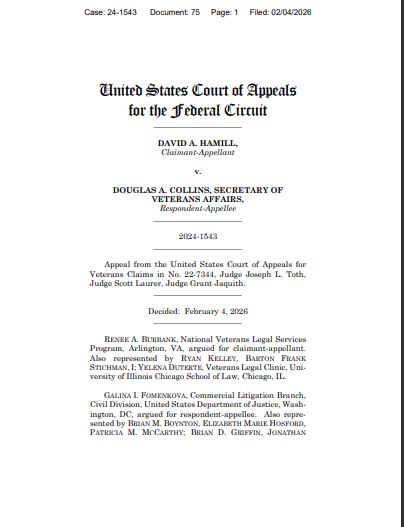 ARLINGTON, VA—Today, the United States Court of Appeals for the Federal Circuit held that the Department of Veterans Affairs (VA) can no longer deny a veteran’s claim without explicitly telling the veteran. In its opinion in Hamill v. Collins, the Federal Circuit decided that a 2017 law, which added more notice requirements for VA’s decisions, eliminated what is known as the implicit denial doctrine. Mr. Hamill is represented by the Veterans Legal Clinic at the University of Illinois Chicago School of Law (UIC Law) and the National Veterans Legal Services Program (NVLSP).
For over a decade, David Hamill, who served in the United States Marines Corps, sought VA disability benefits because of his post-traumatic stress disorder, other mental health conditions, and back pain. The VA, however, would not grant him disability compensation because he was discharged with an “other than honorable” characterization of service. In 2021, with the help of the Veterans Legal Clinic, Mr. Hamill again sought VA benefits and for VA to reopen its prior character of discharge determination. The VA provided a decision about certain other benefits, but it never addressed the character of discharge determination. When Mr. Hamill petitioned in court for VA to give him a decision on that issue, VA argued that it did not have to provide a decision because VA had already implicitly denied Mr. Hamill’s claim.
On appeal to the Federal Circuit, the court held that, under the Veterans Appeals Improvement and Modernization Act of 2017, VA cannot implicitly deny claims. The court concluded that the 2017 law “deliberately and clearly heightened the notice requirement for VA’s initial decisions beyond what was previously acceptable,” and the VA must now provide explicit notice of its denials. “After all,” the court explained, “no veteran can appeal a decision he does not understand to have been made.”
“Veterans, especially those with lower than honorable discharges, need to receive clear decision by the VA,” said Yelena Duterte, lead counsel in this case and Associate Professor of Law and Director of the Veterans Legal Clinic at UIC Law. “Failing to make a decision, as they did here, on a veteran’s status may create a barrier to healthcare, compensation, and other VA benefits. Although Mr. Hamill is now honorably discharged, he understands the importance of setting a precedent for veterans who come behind him to receive due process in the VA system.”
“Veterans deserve to know what the VA is doing with their claims,” said Renee Burbank, Director of Litigation at National Veterans Legal Service Program (NVLSP) and co-counsel in the case. “Congress emphasized how important it is for veterans to understand VA decisions, and the Federal Circuit rightly concluded that there is no place for implicit denials in VA’s modernized appeals system.”
About UIC Veterans Legal Clinic
In 2006, three law students recognized that veterans were having trouble navigating the Veterans Benefits Administration claims process. In an effort to provide legal assistance to such veterans, they created the Veterans Legal Clinic (VLC). Dedicated to training law students to become zealous advocates for veterans and their families, the clinic handles all aspects of Veteran Benefits Administration claims, from the initial factual intake to the technical representation of claims at the appellate level. The clinic is also involved in court programs for veterans at the federal level and assists veterans who would like to pursue a discharge upgrade in order to obtain veterans benefits. For more information, go to uic.edu.
About NVLSP
The National Veterans Legal Services Program (NVLSP) is an independent, nonprofit veterans service organization that has served active duty military personnel and veterans since 1981. NVLSP strives to ensure that our nation honors its commitment to its 18 million veterans and active duty personnel by ensuring they have the benefits they have earned through their service to our country. NVLSP has represented veterans in lawsuits that compelled enforcement of the law where the VA or other military services denied benefits to veterans in violation of the law. NVLSP’s success in these lawsuits has resulted in more than $7.2 billion dollars being awarded in disability, death and medical benefits to hundreds of thousands of veterans and their survivors. NVLSP offers training for attorneys and other advocates; connects veterans and active duty personnel with pro bono legal help when seeking disability benefits; publishes the nation’s definitive guide on veteran benefits; and represents and litigates for veterans and their families before the VA, military discharge review agencies and federal courts. For more information, go to nvlsp.org.
Media contact:
Patty Briotta, office 202-621-5698, patty@nvlsp.org